Type description:
E--Company name: Enboli
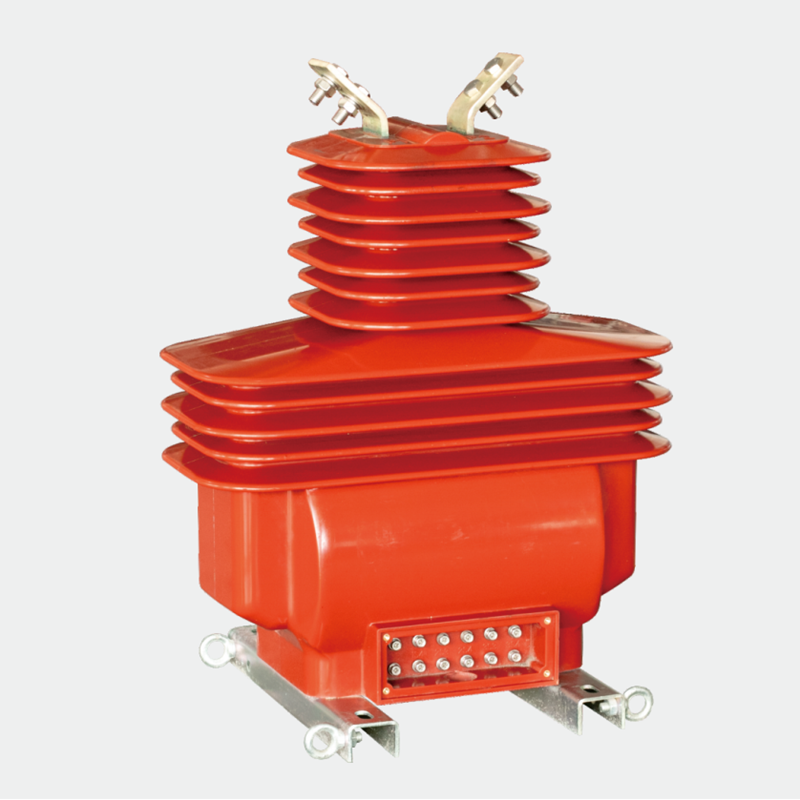
L--Current transformer
Z--Post type
Z--Casting insulation
W--Outdoor type
33R--Rated voltage(kV)
Technical data
Two windeings:0.5/5P
Rated primary Current(A) | Accuracy classes combination | Rated secondary output(VA) | Short-time thermal current(KA) | Rated dynamic current(KA) | |||
0.2(S) | 0.5 | 5P20 | |||||
20-100 | 0.2(s)/5p20/5p20 0.5/5p20/5p20 | 10 | 15 | 15 | 0.06l1n | 0.15l1n | |
150-200 | 9 | 22.5 | |||||
300-500 | 18 | 45 | |||||
600-1200 | 15 | 30 | 20 | 36 | 90 | ||
1500-200 | 20 | 40 | 30 | 80 | 160 | ||
Overall dimension drawing
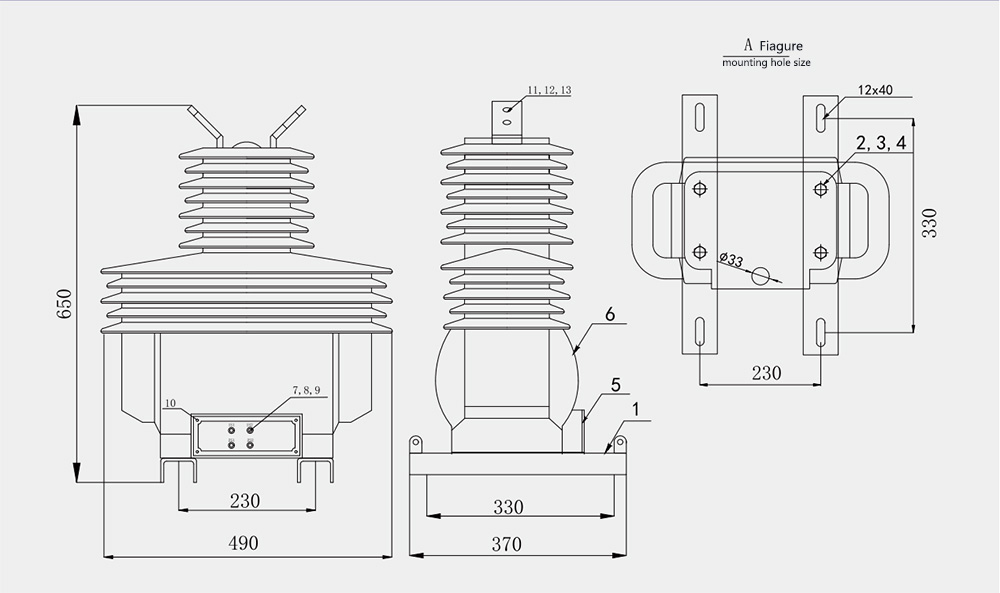
FAQ:
What is the difference between CT and VT transformers?
CT is used as the abbreviated name to represent a current transformer.
PT (or sometimes VT) is used to denote a potential transformer.
CT reduces the large current to a safer and measurable level. PT reduces a high voltage to a safer and measurable level.
What is outdoor current transformer?
Outdoor current transformer designed for high current metering and relaying. Up to 4 cores.
Resistant to outdoor conditions. Hydrophobic material offers superior outdoor performance and minimizes the potential for flashover.
Terminology interpretation:
1.The meaning of rated insulation level
The rated insulation level is the value of the impulse withstand voltage and the value of the power frequency withstand voltage,
which together characterise the insulation of the switchgear with regard to its ability to withstand the electric stresses.
2. The meaning of the secondary current.
The secondary current is usually rated at a standard 1 Ampere or 5 Amperes for larger primary current ratings.
There are three basic types of current transformers: wound, toroidal and bar.
3. The meaning of metering current transformer.
A metering current transformer is designed to measure current continuously and work accurately within the rated current range.
Current error and phase displacement limits are determined by the accuracy class. Accuracy classes are: 0.1, 0.2, 0.5 and 1.
4.What is voltage ratio?
The ratio of primary voltage to secondary voltage is known as the voltage ratio (VR).
As mentioned previously, the ratio of primary turns of wire to secondary turns of wire is known as the turns ratio (TR).